Decoration guide · · By the CHSALL team
Sublimation vs rhinestone: which decoration for cheer uniforms?
Two methods do almost all the decorative work on a cheer uniform. Here is how printed sublimation and hand-applied rhinestones differ in look, durability, care and cost, and why most competition uniforms use both.
Key takeaways
- Sublimation prints the design into the fabric with heat, so the colour becomes part of the material: nothing to peel, no raised surface, no added weight.
- Rhinestones are individual stones set by hand, which is what produces the dimensional sparkle that reads under competition lighting. Coverage is what drives the labour cost.
- Most competition uniforms combine both: a sublimated base carrying the colour and pattern, with stones on the front panel, logo and lettering.
- Care differs: printed areas are essentially wash-and-wear, while stones need cold washing inside out and no high-heat drying.
When coaches compare uniform designs, the conversation usually starts with artwork. The decision that actually changes how the uniform looks on the mat, and what it costs, is the decoration method underneath that artwork.
How sublimation works
Dye-sublimation uses heat to turn solid dye into gas, which then bonds with the polymer fibres of a polyester fabric. The colour ends up inside the fabric rather than sitting on top of it. That single fact explains almost every practical difference:
- Nothing to peel or crack. There is no plastic layer on the surface, so there is no print edge to lift after a season of washing.
- No meaningful added weight. Printed areas add essentially nothing, which matters on a garment athletes stunt and tumble in.
- Designs can flow across seams and panels. Because the fabric is printed before it is cut and sewn, a pattern can run continuously from the sleeve across the body.
- Colour does not wear off the surface the way a surface print can, because the colour is part of the fibre.
One limitation is worth knowing before you finalise artwork: sublimation cannot print white ink. Designs with white or very light areas are produced by printing onto a white polyester base and letting the fabric show through. That is also how dark uniforms are made: the whole garment is printed, background included, on a white base.
How rhinestones work
Hot-fix rhinestones carry a heat-activated adhesive on the back. They are positioned and bonded with a heat press or an applicator, and on complex layouts a large share of the placement is done by hand.
What you get in return is sparkle that behaves like a light source. Stones catch stage lighting and change as the athlete moves, and that movement is what reads from the back of an arena. Printed sparkle is flat by comparison: it can suggest glitter, but it cannot throw light.
The trade-off is labour. A logo and lettering is a modest number of stones. A fully stoned front panel, with gradients and outlined shapes, can run into thousands, each placed individually. Stones also come in fixed sizes and colour ranges, so a stoned area is an interpretation of a gradient rather than an exact copy.
Side by side
| Aspect | Sublimated print | Rhinestones |
|---|---|---|
| Look | Flat, sharp detail, unlimited colour | Dimensional sparkle that reacts to lighting |
| Colour matching | Can be matched closely to team colours | Set stone colours; gradients are approximated |
| Added weight | None | Small, but noticeable at heavy coverage |
| Durability | Part of the fabric; cannot peel or crack | Secure when applied well; single stones can be lost under hard wear |
| Washing | Normal gentle wash | Cold, inside out, no high-heat drying |
| Repair | Not needed | An individual stone can be re-set |
| Relative cost | Lower: produced by machine | Higher: hand work, scaling with coverage |
| Effect on lead time | Minimal | Heavier coverage means more production days |
Which should your team choose?
| Situation | Typical choice |
|---|---|
| Practice wear and weekly training | Sublimation only. It survives constant washing and costs less per piece. See practice wear. |
| School and youth teams | Sublimated base with light stone accents on the logo and lettering. |
| All-star and competition | Sublimated base plus heavy stone coverage on the front panel, logo and lettering. |
| Skating and dance | Often stone-heavy, because the sparkle is part of the presentation under spotlights. |
How to combine both well
- Print the colour, stone the light. Let the printed base carry the design, the panels and the colour, and spend stones where the eye lands first.
- Concentrate coverage. Front panel, logo and lettering give most of the visual impact. Stones on the back or under the arms are rarely seen and are the first to be abraded.
- Keep stone colours in the same family as the print. Mixing a printed gradient with an unrelated stone colour is the most common way a good design looks accidental.
- Decide coverage before you ask for a quote. Coverage changes both the price and the production time, so it belongs in the brief rather than in a later revision.
Care that keeps both looking new
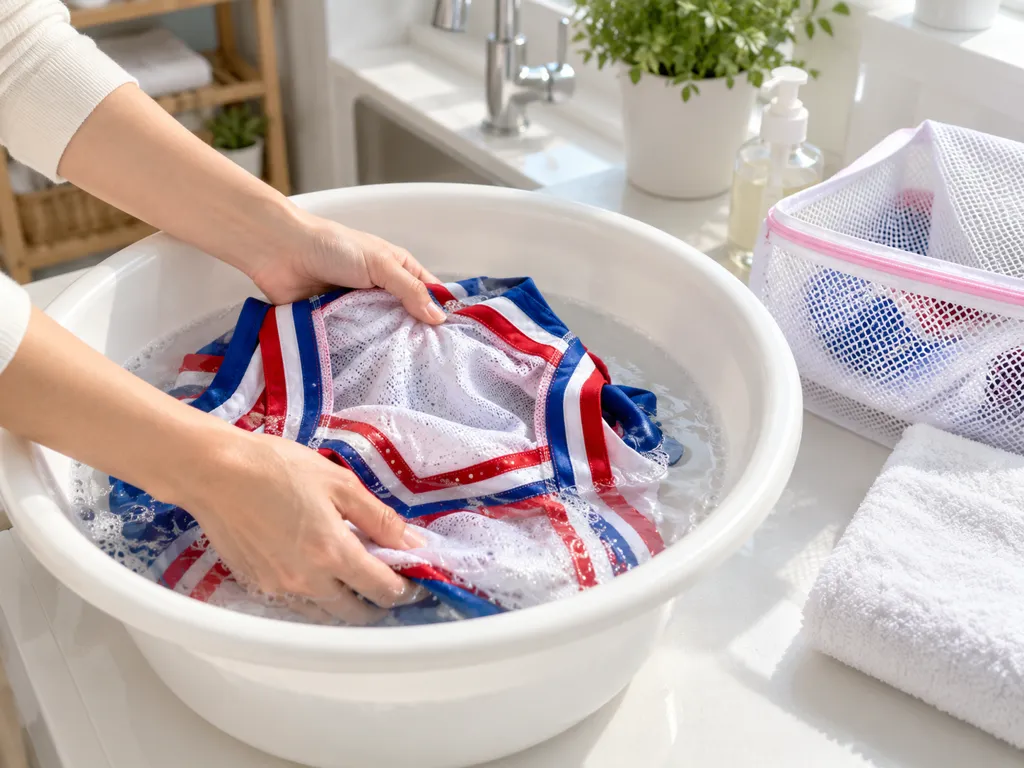
- Wash cold and inside out, on a gentle cycle or by hand.
- No bleach and no fabric softener, which attack both the print and the adhesive.
- Air dry. If you must tumble dry, keep the heat low.
- Store uniforms on hangers or folded with the stoned side facing inwards to reduce abrasion.
For a full routine, see our guide to washing a cheer uniform without losing rhinestones.
What this means for your quote
Tell us three things and we can quote accurately: the design you want, roughly how much stone coverage, and your quantity and deadline. Our general MOQ is 10 pcs and production is 10–25 days after the design and sizes are confirmed; heavier stone work sits towards the longer end.
Send your design and coverage and we will confirm the price, the schedule and what is included.
FAQ
What is the difference between sublimation and rhinestones on a cheer uniform?
Sublimation prints the design into the fabric with heat, so the colour becomes part of the material: no raised surface, no added weight and nothing to peel off. Rhinestones are individual stones bonded to the surface by hand or with a press, which gives dimensional sparkle under competition lighting but adds labour, some weight and a different care routine.
Which is better for a competition cheer uniform?
Most competition uniforms use both: a sublimated base that carries the colour and pattern, with rhinestone coverage on the front panel, logo and lettering where the sparkle reads under stage lighting. Print alone tends to look flat under lights; stones alone are expensive to cover a whole uniform with.
Do rhinestones fall off cheer uniforms?
Correctly applied hot-fix stones hold well through a season. Individual stones can be dislodged by hard wear or by the wrong washing routine, and a single stone can be re-set. Cold washing inside out, no bleach and no high-heat tumble drying greatly reduce losses.
Which decoration is cheaper?
Sublimated print is produced by machine and costs less. Rhinestone work is applied largely by hand, so the price scales with coverage: a logo and lettering is a modest number of stones, while a fully stoned front panel can involve thousands. Your quote reflects the coverage you choose.
Deciding on decoration?
Send your design and the stone coverage you have in mind and we will quote both options side by side. General MOQ 10 pcs, production 10–25 days.