Fabric guide · · By the CHSALL team
Polyester vs spandex for cheer uniforms
Cheer uniforms are almost never made from a single fibre, and the reason is that the two fibres do different jobs. Here is what each one contributes, why composition affects both the print and the stones, and what to ask for when you specify fabric.
Key takeaways
- Polyester carries the design: it takes dye-sublimation, holds colour and resists wear. On its own it has little stretch.
- Spandex (elastane) provides stretch and recovery, and is used in a small percentage in the blend rather than as the main fibre.
- Composition is not a detail: sublimation needs a polyester-dominant surface, and stone-heavy panels sit better on stable fabric.
- Ask for the fibre composition, the weight in gsm and the stretch direction, not the phrase "performance fabric".
Fabric is the part of a uniform brief that gets the least attention and causes the most disagreement later. Two uniforms can look identical in a photo and behave completely differently after a season of stunting and washing, because the fibres underneath are different.
What each fibre does
| Fibre | What it brings | Where you see it |
|---|---|---|
| Polyester | Strong and quick-drying; takes dye-sublimation well; holds colour and resists abrasion. Little natural stretch. | The body of almost every cheer top, skirt and leotard. |
| Spandex (elastane) | Stretch and, just as importantly, recovery: it returns the garment to shape instead of leaving it stretched. | A small percentage blended into the body fabric, and a higher share in stretch mesh panels. |
| Nylon | Soft, strong and smooth; good for linings and briefs. | Linings, briefs, some practice wear. |
| Cotton | Comfortable and breathable, but heavy when wet and not suitable for sublimation. | Rarely in competition garments; occasionally in casual practice items. |
Why almost every uniform is a blend
Polyester alone would print beautifully and then refuse to move with the athlete. Spandex alone would stretch and would not carry the print. Combining them gives a fabric that does both, which is why the typical cheer body fabric is polyester-dominant with a small percentage of spandex.
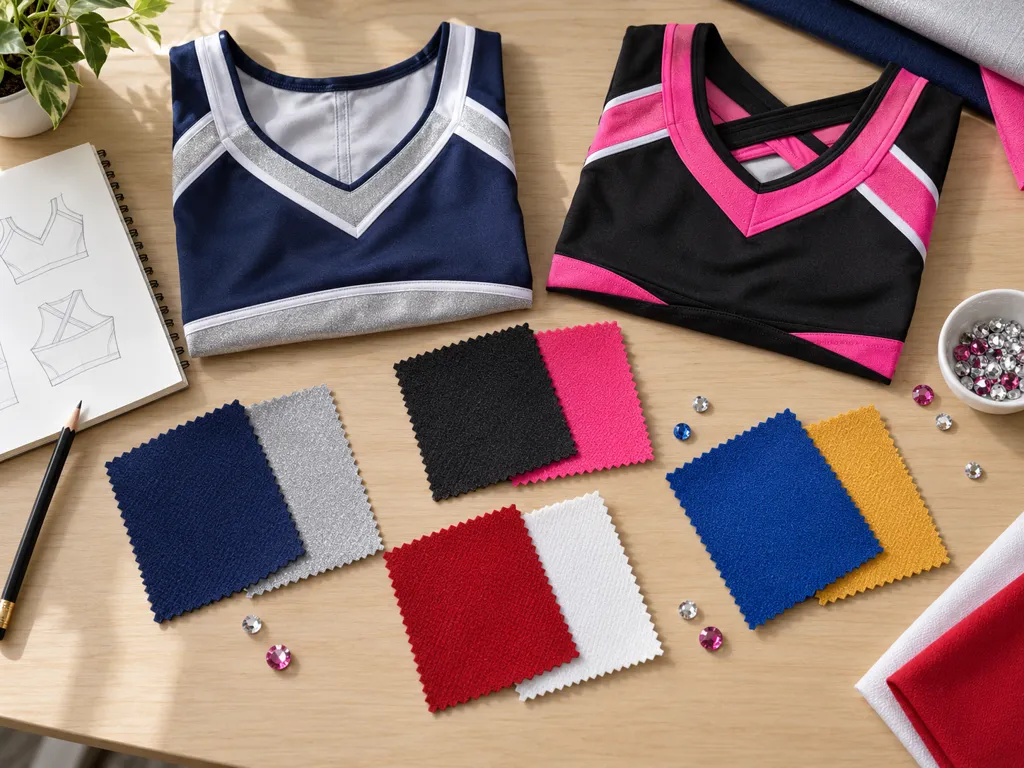
Exact percentages vary by style, by supplier and by what the garment has to do. Rather than assuming, ask for the composition of the specific fabric used in your style, and ask for a swatch if the order is for competition.
| Part of the garment | Typical construction | Why |
|---|---|---|
| Body (top, skirt, leotard) | Polyester-dominant knit with a small spandex content | Printable, durable, and stretchy enough to move without distorting |
| Stretch mesh panels | Higher spandex content, open knit | Ventilation and fit at the waist, sides and underarm areas |
| Lining and brief | Soft knit, often nylon and spandex | Comfort against the skin and opacity |
Why composition affects the decoration
- Sublimation needs polyester. The dye bonds with polymer fibres under heat. If the fabric is not polyester-dominant, the print will not develop properly, which is why a printable body fabric is selected for the design rather than chosen purely on feel.
- Stones need a stable surface. A heavily stoned panel sitting on fabric that stretches a lot will work the adhesive over time. That is one reason heavy stone coverage is often placed on the front panel rather than on the most elastic areas.
- Mesh and stretch panels are usually left plain. They are there for ventilation and movement; printing and stoning them is possible but adds cost for little visual return.
For more on how the decoration methods behave, see sublimation vs rhinestone cheer uniforms.
Stretch, recovery and fit
Stretch gets all the attention, but recovery is what you notice by mid-season. A fabric that stretches easily and springs back keeps its shape; a fabric that stretches and stays stretched sags at the waist and the seat after a few months.
This is also why measuring your athletes matters more than ordering to a self-reported size: a garment with good recovery fits the body it was measured for, and a garment sized on guesswork does not.
Weight and hand feel
Fabric weight is usually quoted in grams per square metre (gsm). Heavier knits feel more substantial, drape with less show-through and tend to hide construction detail; lighter knits feel cooler and more athletic. There is no single right answer for cheer, but there is a right answer for your team, and you can only judge it in the hand.
Ask for the gsm figure and a swatch. Weight alone will not tell you how a fabric will look once it is printed and stoned.
What to ask when you specify fabric
- Fibre composition, as percentages by fibre
- Weight in gsm
- Stretch direction (two-way or four-way) and how it recovers
- Whether the fabric is suitable for sublimation
- Colour fastness and recommended washing
- Whether a swatch or print proof is available before production
Care implications
Synthetic blends have one main enemy: heat. Cold or cool washing, no bleach, no fabric softener and air drying keep both the spandex and any rhinestone adhesive in good condition. For the full routine, see our guide to washing a cheer uniform without losing rhinestones.
The practical answer
- Competition uniform: polyester-dominant performance knit body with mesh panels, sublimated base design, stones on the front panel, logo and lettering.
- Practice wear: a durable printable knit, print-only, chosen for how it survives constant washing.
- Leotards and skating dresses: a stretch fabric chosen for movement and line, with decoration matched to how the garment is used.
Tell us how the garment will be used, and we will confirm the fabric specification used in that style, along with the composition and weight. Our general MOQ is 10 pcs and production is 10–25 days after the design and sizes are confirmed.
Send your requirement and ask for the fabric spec and a swatch with your quote.
FAQ
Is a cheer uniform polyester or spandex?
Almost always both. The body of a cheer uniform is typically polyester-dominant, with a small percentage of spandex for stretch and recovery. Polyester carries the print and holds the colour; spandex lets the garment move with the athlete and return to shape.
Why is spandex only a small part of the blend?
Two reasons. A small percentage is enough to give the stretch a uniform needs, and sublimation printing needs a polyester-dominant surface to bond properly. High spandex content also changes how a stoned panel behaves, so stone-heavy areas are usually placed on more stable fabric.
What fabric should I ask for in a cheer uniform?
Ask for the fabric name, the fibre composition as percentages, the weight in gsm, the stretch direction and recovery, and whether it is suitable for sublimation. A swatch is worth requesting for competition garments, because a weight difference and a slight colour shift are obvious in the hand and on the mat.
How should synthetic cheer uniform fabric be washed?
Cold water, gentle cycle or hand wash, no bleach and no fabric softener, and air dry rather than high-heat tumble drying. Heat is what degrades spandex over time, so a cool wash routine extends the life of the garment as much as it protects any rhinestones.
Want the fabric spec before you decide?
Tell us how the garment will be used and we will include the composition, weight and a swatch option with your quote. General MOQ 10 pcs, production 10–25 days.