Guide · · By the CHSALL team
How many practice sets does a cheer team need?
How many cheer practice sets a team actually needs: counting by practice days per week, camp weeks, laundry turnaround and spares, with a worked example.
Key takeaways
- Count practice days per week first, not roster size. A team training three times a week needs two sets per athlete as a baseline.
- Laundry turnaround sets the floor: if athletes wash once a week, one set per athlete is not enough whatever the roster size.
- Camp weeks and travel weeks are a separate count, not part of the normal weekly rotation.
- Add spares from the middle of your size curve rather than the extremes, and expect a second order as athletes join.
Most teams get this wrong in the same direction. The count is built from the roster size, the order arrives, and by the second month half the team is rotating the same two sets while the rest sit unworn because they are the wrong sizes. The number that actually matters is practice days per week.
Start with practice days per week
A set is worn once and then needs washing. So the question is not how many athletes you have, it is how many wears you need to cover between washes. A team training twice a week can live on one set per athlete plus a spare top. A team training four or five times a week cannot, no matter how the order is priced.
The laundry turnaround rule
Ask how the kit is washed before you ask how many to buy. Two situations cover most programs:
- Athletes take kit home. If the family washes once a week, every practice day in that week needs a clean set. Three practices a week means three sets, or two sets plus a midweek wash.
- The gym or club handles laundry. If kit comes back clean within 24 hours, one set per athlete plus spares is workable, and the count drops sharply.
If you do not know which applies, assume the first. It is the more common case and the safer number to order.
Working numbers by practice frequency
| Practice days per week | Sets per athlete | Why |
|---|---|---|
| 1 to 2 | 1, plus a spare top | One set washes and dries between sessions |
| 3 | 2 to 3 | Two sets work only with a midweek wash |
| 4 to 5 | 3 to 4 | Wear exceeds any single-week wash cycle |
| Camp week on top of normal training | Add 1 | Camp days are long and often back to back |
Camp weeks and travel weeks are a separate count
Camp and travel are where teams most often run out. A camp week can mean five consecutive wear days with no realistic washing window, and travel adds the problem of packing wet kit. Treat these as extra sets rather than borrowing from the weekly rotation, and expect to pack a spare top even when the count looks generous on paper.
How many spares to add
Spares are not a rounding error, they are the difference between an order that still works in March and one that does not. Two rules of thumb help:
- Size the spares to the middle of your curve. Most new joiners land in the middle sizes, so spares concentrated at the extremes tend to sit unused.
- Plan for growth. Athletes change size between seasons, and a set ordered for a growing athlete rarely lasts two years. Adding a few pieces to the original order is far cheaper than placing a small repeat order later.
A worked example
A 24 athlete team training three times a week, with one camp week and no club laundry:
- Weekly rotation: 2 sets per athlete = 48 sets.
- Camp week: 1 extra set per athlete = 24 sets.
- Spares: about 10 percent in the middle sizes = 5 sets.
- Total: roughly 77 sets across the full season, ordered in two waves so the camp layer arrives before camp.
The exact ratio matters less than the structure. Once you know practice days, laundry turnaround and the camp calendar, the number follows, and you can see immediately whether one order covers the season or two waves make more sense.
How this changes the order you place
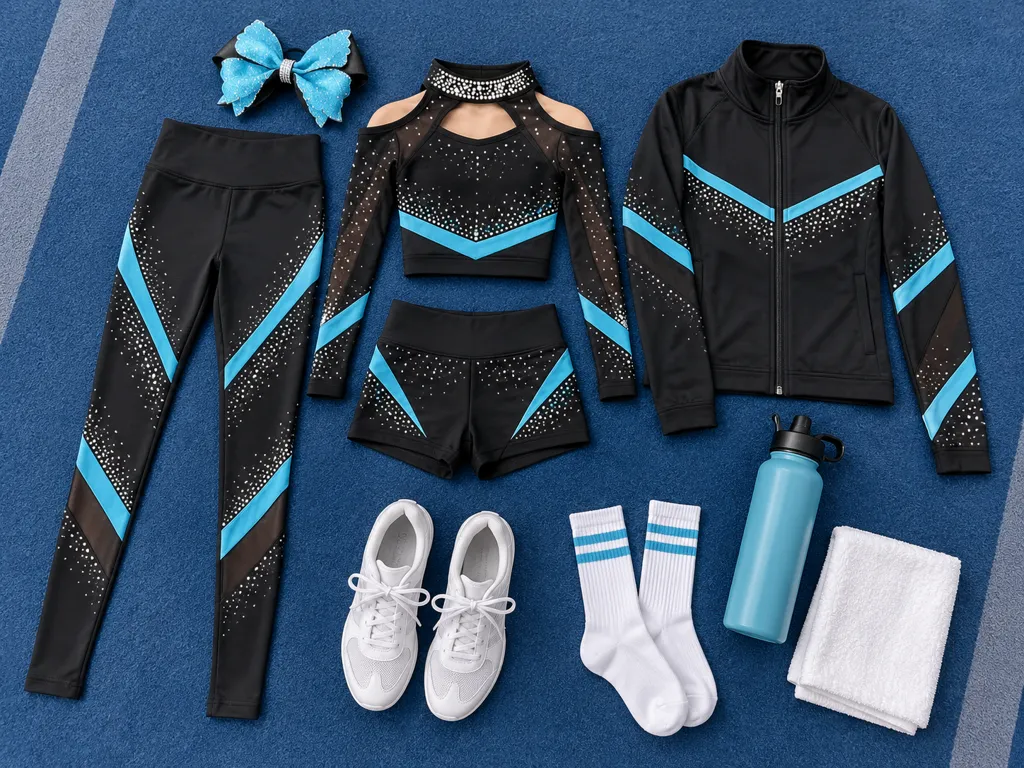
Two practical consequences. First, a practice set order is usually large enough to clear a minimum easily, so splitting it into a light set and a warm layer in two waves is realistic rather than wasteful. Second, practice sets are reordered far more often than competition uniforms, so keep the exact style, fabric and color references on file after the first order. See our cheer practice wear styles for the set options, and how to layer them through the year in practice wear by season. For a starting point on what a set actually looks like, this practice uniform set is a typical team shape: top, shorts and a consistent color story.
If the count still feels high, the lever is usually laundry rather than quantity. Read what to wear to cheer practice for which pieces are genuinely needed per session, and how to collect team sizes before you place the order. Gyms and brands ordering across several teams are covered by our wholesale and OEM programme.
FAQ
How many practice sets should each cheerleader have?
Two to three, depending on how many days a week you practice and whether athletes take their kit home to wash. Athletes training three or more times a week and washing once a week generally need two sets as a minimum, and three if a camp week is coming.
Do athletes buy their own practice wear or does the team order it?
Both patterns are common. Teams that order as one group gain a consistent look and usually a better unit price, while some programs let athletes buy directly to keep the upfront cost off the club. Either way, agree the exact style and colors first so late joiners can be added in a second order.
Should practice wear be ordered together with the competition uniform?
Usually as a separate order. A competition uniform tends to be replaced on a longer cycle, while practice sets wear out faster and are reordered more often as athletes join the program.
Planning team uniforms?
Send your style, colors, quantity and deadline: we reply with a quote. General MOQ 10 pcs, production 10–25 days.